|
 Re: Coyote Behavior
[Re: bearcat2]
#8590204
Re: Coyote Behavior
[Re: bearcat2]
#8590204
03/28/26 10:29 AM
03/28/26 10:29 AM
|
Joined: Jul 2017
South Texas Brush Country
TEJAS

trapper
|
trapper
Joined: Jul 2017
South Texas Brush Country
|
Dang Tejas, looking at that I'd swear he stepped right on the pan in the last pic.
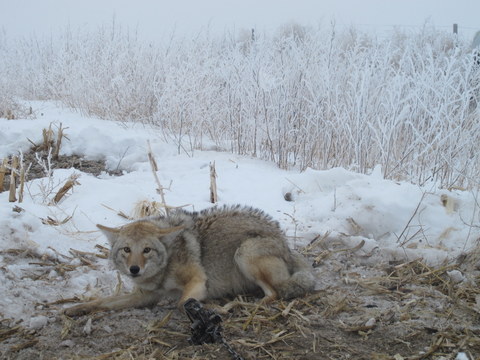
Did he miss it or was there something under it or some other reason it didnt go off? She missed it BC2. The trap pan is right on the X. It might look like a track by the X but there is not. When she excavated the empty trap bed she piled about three inched of dirt right on top of the trap ! So, the tracks you see are on top of three inches of lose dirt. Her main approach on the first dig was at the 4:30 hour. It is evident she hit from the same angle on the second nigh,t but I missed her fronts. Then she just stood there and dug until the trap was completely buried.
|
|
|
Re: Coyote Behavior
[Re: k9-hunter]
#8590241
03/28/26 11:45 AM
03/28/26 11:45 AM
|
Joined: Jan 2017
Marion Kansas
Yes sir
trapper
|
trapper
Joined: Jan 2017
Marion Kansas
|
testing in the summer compared to fall or winter will give you different results and reactions from coyotes even mild food based lures will work better different times of the year what i have found is test while trapping for example i have one farm that i have trapped for nearly 20 years and always catch yotes off this one mound in the first couple of days so if im trying new lures thats the spot i try because i know what works there and a new lure should still produce because the coyotes are there Have u tested year around to confirm this? I for the most part haven't seen any preference difference based off the time of year.
|
|
|
Re: Coyote Behavior
[Re: k9-hunter]
#8590261
03/28/26 12:45 PM
03/28/26 12:45 PM
|
Joined: Jan 2017
Marion Kansas
Yes sir
trapper
|
trapper
Joined: Jan 2017
Marion Kansas
|
limited testing as most of my coyote trapping is done in the winter but i have trapped problem coyotes in the summer and noticed the difference some of my top producing loud lures dont seem to work as great in the summer or early fall and if you read up on some lure makers posts they will sometimes say when a lure will shine Ive seen stuff lure makers have said that dont pan out when you ask the coyotes. And I've talked with more than a few lure makers and wonder how much "testing " some of them do? Lot of stuff kind of seems a little logical then gets said enough that it's taken for truth. And when you start testing it it doesn't quite hold water.
|
|
|
Re: Coyote Behavior
[Re: silkyplainscoyot]
#8590389
03/28/26 06:02 PM
03/28/26 06:02 PM
|
Joined: Jul 2017
South Texas Brush Country
TEJAS
trapper
|
trapper
Joined: Jul 2017
South Texas Brush Country
|
I have read Kirk's book. I believe he has some very valid points. It has to do with EMF, Electromagnetic fields put off by metal. There are a lot of variables to consider though. The further north you go and the dryer the soil it's not going to transmit as much. Also, he found that better qualities of metal didn't put off a high field reading. So many may have not experienced many problems depending on where they live, soil conditions and the brand of trap, they used. He even stated it's a learned behavior not something they are born with. So, it's the older adult animals that would more than likely be the culprits.
I do believe animals can detect it and that may be the case as why some digging occurs with a trap bedded in front of a bait/lure test. SPC, one of the things that makes the magnetic field theory hard to buy into for me is the extensive list of variables that can and do illicit the same exact response. I don’t see how this theory could be singled out as the primary suspect amongst a lineup of known repeat offenders. Then you have a host of conductive minerals called "Hot" rocks that will trip a metal detector just like a steel trap would. If a coyote can indeed notice these magnetic fields, how could he isolate a handful of steel traps amongst thousands of acres of conductive mineral rocks ? Now I understand there are places void of these conductive minerals as well. Maybe that is the caveat. It is certainly not the case here, The area I trap is very rich in iron deposits. You cannot make a single sweep with the metal detector coil without it going off in most cases. Maybe that along with dry conditions is why I don’t have any trouble. Come to think of it I always thought the old theory that a coyote can detect the oxidation of the trap with his nose could be plausible. Either way they are very interesting subjects that warrant more study.
|
|
|
Re: Coyote Behavior
[Re: Yes sir]
#8590518
03/28/26 10:19 PM
03/28/26 10:19 PM
|
Joined: Jul 2017
South Texas Brush Country
TEJAS
trapper
|
trapper
Joined: Jul 2017
South Texas Brush Country
|
Tejas I agree its usually a variety or combination of things but if a person or animal knows to look for an object or is looking for a particular object they are we more app to find it. I think maybe the difference between the "dumb" not knowing the trap is there and the wiser ones finding a trap is the one is looking for it. And if the have a particular spot to look for the can miss another one. YS,, I believe most trappers gravely underestimate how good of a memory a coyote has.. The more repetition you show a coyote the more education he gains. It is a s simple as that.
|
|
|
Re: Coyote Behavior
[Re: Slipknot]
#8590551
03/29/26 01:17 AM
03/29/26 01:17 AM
|
Joined: Mar 2010
SD
Boone Liane
trapper
|
trapper
Joined: Mar 2010
SD
|
They can absolutely smell rust.
Every spring it seems I will have a trap that probably should have been swapped out for a clean one get dug because it’s rusty. But I always seem to be rationing and trying to stretch out my trap supply so I do end up pushing my luck sometimes.
Doesn’t seem to happen to clean, or even dirty but non-rusty traps.
Light rust doesn’t concern me, but when it starts getting real crusty it’s a problem.
But I firmly believe in many situations they already know “somethings there”. Even a clean trap at a fresh set. They just don’t know what it is or care what it is, why would they? There’s rusty metal buried all over out there.
Iron, trap coatings, rust, fresh dirt smell, loose dirt, etc, coupled with human smell, are all potential red flags for certain animals.
Most dug trap problems I have are the result of skunks, fox, and other critters (swift fox are the WORST). And I believe most issues relating to dug or scratched at traps are a result of severe scent contamination, really poor bedding, or loose soil over the trap. I’ll have a lot more problems if I don’t firm up my trap bed, especially in warmer weather with real tentative coyotes.
A truly educated, smart coyote just leaves it all alone and most trappers likely never even know that animal exists.
I bury my traps pretty deep. Usually 1.5-2”.
That helps hide any wiggle there might be. Once I firm up 2” it may end up just being one depending on soil type. The wind may take 1/2”. And, should an animal scratch at it, I’d rather they not find something with an easy swipe or two. If they find something fast and easy, they’re going to continue to work at it. If they don’t, they may satisfy their curiosity, move on and get caught.
|
|
|
Re: Coyote Behavior
[Re: Slipknot]
#8590852
03/29/26 05:38 PM
03/29/26 05:38 PM
|
Joined: Jun 2022
Manitoba
Shakeyjake
trapper
|
trapper
Joined: Jun 2022
Manitoba
|
Great discussion you started Slipknot! The kind that the best K9 trappers can read and post……like some of them already have.
Were you diagnosed early? My wife’s uncle had trouble taking a leak for 4 friggin years. You know how us guts are though. Had he gone in a year ago, it would’ve been not too bad and treatable, but now it’s too late. He still running around and having fun, but the days are numbered. Good thing he retired at 55yrs old and spent some of his pension.
Good luck, God bless and hang in there SK!
Last edited by Shakeyjake; 03/29/26 05:39 PM.
Wind Blew, crap flew, out came the line crew https://youtube.com/@drtrapping www.trapper.ca
|
|
|
Re: Coyote Behavior
[Re: Slipknot]
#8590878
03/29/26 07:02 PM
03/29/26 07:02 PM
|
Joined: Jun 2022
Manitoba
Shakeyjake
trapper
|
trapper
Joined: Jun 2022
Manitoba
|
Right on SK! That’s good news, you’re gonna be all fine.
Wind Blew, crap flew, out came the line crew https://youtube.com/@drtrapping www.trapper.ca
|
|
|
Re: Coyote Behavior
[Re: TEJAS]
#8590890
03/29/26 07:36 PM
03/29/26 07:36 PM
|
Joined: Apr 2012
Nebraska
silkyplainscoyot
trapper
|
trapper
Joined: Apr 2012
Nebraska
|
I have read Kirk's book. I believe he has some very valid points. It has to do with EMF, Electromagnetic fields put off by metal. There are a lot of variables to consider though. The further north you go and the dryer the soil it's not going to transmit as much. Also, he found that better qualities of metal didn't put off a high field reading. So many may have not experienced many problems depending on where they live, soil conditions and the brand of trap, they used. He even stated it's a learned behavior not something they are born with. So, it's the older adult animals that would more than likely be the culprits.
I do believe animals can detect it and that may be the case as why some digging occurs with a trap bedded in front of a bait/lure test. SPC, one of the things that makes the magnetic field theory hard to buy into for me is the extensive list of variables that can and do illicit the same exact response. I don’t see how this theory could be singled out as the primary suspect amongst a lineup of known repeat offenders. Then you have a host of conductive minerals called "Hot" rocks that will trip a metal detector just like a steel trap would. If a coyote can indeed notice these magnetic fields, how could he isolate a handful of steel traps amongst thousands of acres of conductive mineral rocks ? Now I understand there are places void of these conductive minerals as well. Maybe that is the caveat. It is certainly not the case here, The area I trap is very rich in iron deposits. You cannot make a single sweep with the metal detector coil without it going off in most cases. Maybe that along with dry conditions is why I don’t have any trouble. Come to think of it I always thought the old theory that a coyote can detect the oxidation of the trap with his nose could be plausible. Either way they are very interesting subjects that warrant more study. I understand the variables could bring up questions. That's why for the most part I don't think it affects trappers to an extent be concerned with it. But I guess I'm not ready to discredit the fact that some animals can detect it. Maybe certain animals more than others. I know a lot of Kirk's testing was probably geared more towards Beaver and he felt it really gave him the upper hand on those educated adult ones. Then when you're targeting animals with the use of cages, I would imagine it would generate a greater emf in that area. Here's the forward to his book stating the testing that was done: My findings based on infield testing, observation, real-time video, research periodicals, scientific studies, and reading trappers experiences with the devices mentioned. This work was done over 23 years trapping professionally. During this time, I experimented with body grip traps, round and standard, of various sizes. Snares and foothold traps were used of several sizes and snare lock types. Testing was done with experience from over 120 different cage trap designs, many having multiple sizes in length, width, and height, as well as trigger design. They were square, round, rectangle, triangle, and pyramid in shape. This included doors that locked with rings, powered and not. Traps with powered saloon-style doors on each end. Guillotine doors of various designs. Many had swing-down powered lock bar doors combined with some traps that had at least three different door designs on the same trap. Triggers on the cage traps used have been multiple numbers of pan designs to over six different wire trigger styles and type. Using trapping devices over 18,000 animals were caught, in the wild, and over 60,000 sets were made. During a 13 year period, of the 23 years, over 400 locations were set each year. More than one hundred thousand acres were accessed and over 14,000 animals were caught. In most of the 13 years, the bulk of trapping was done, in less than 120 days, with a 24hr check. 95% of the work that was done removing animals was Animal Damage Control. It wasn’t until a magnetometer was purchased that the way the animals were responding to set traps and hunting/ trapping devices made complete sense. For almost four years, I suspected, with very strong beliefs, but never could prove scientifically. I was always given doubt, from my findings, by respected professionals that I thought had the same experiences I had and the ability to interpret them. Concentrating on “the most effective traps”, the only thing they “all” had in common was a decrease in magnetic field intensity and a larger percentage of adult animals being caught in the traps with fewer refusals.
|
|
|
Re: Coyote Behavior
[Re: Slipknot]
#8590911
03/29/26 08:04 PM
03/29/26 08:04 PM
|
Joined: Jun 2022
Manitoba
Shakeyjake
trapper
|
trapper
Joined: Jun 2022
Manitoba
|
I’m guessing this book is called AN OUTDOORSMAN'S GREATEST DISCOVERY FOR THE 21ST CENTURY?
Sounds interesting. Figured it should be a good read and worth ordering.
Wind Blew, crap flew, out came the line crew https://youtube.com/@drtrapping www.trapper.ca
|
|
|
|
|